Welcome: SHANDONG YESMORE LOGISTICS CO.,LTD
Language:
 ∷
∷

∷
 ∷
∷


As large-scale models evolve and AI server power consumption climbs, traditional air cooling is hitting physical limits. Liquid cooling technology is entering a period of rapid industrial expansion, shifting from a "nice-to-have" feature to essential infrastructure for high-density intelligent computing centers.

Traditional air-cooling methods—relying on fans and air conditioning—are increasingly struggling to handle high-power GPU clusters. With rising rack power densities and intense heat concentration at the chip level, air cooling not only lacks sufficient cooling capacity but also leads to issues such as high energy consumption, thermal throttling, and accelerated hardware aging. Over 80% of existing air-cooled data centers in China hold immense potential for future retrofitting with liquid cooling systems.
The industry has currently converged on three mainstream liquid cooling technology paths. Cold-plate liquid cooling is the dominant market choice due to its mature technology and ease of implementation. It removes heat by circulating coolant through cold plates attached directly to the chips, requiring no changes to the server's overall structure. However, as single-unit power exceeds 100kW, the thermal management demands on cold-plate systems rise significantly, making them difficult to adapt to ultra-high-power rack scenarios.
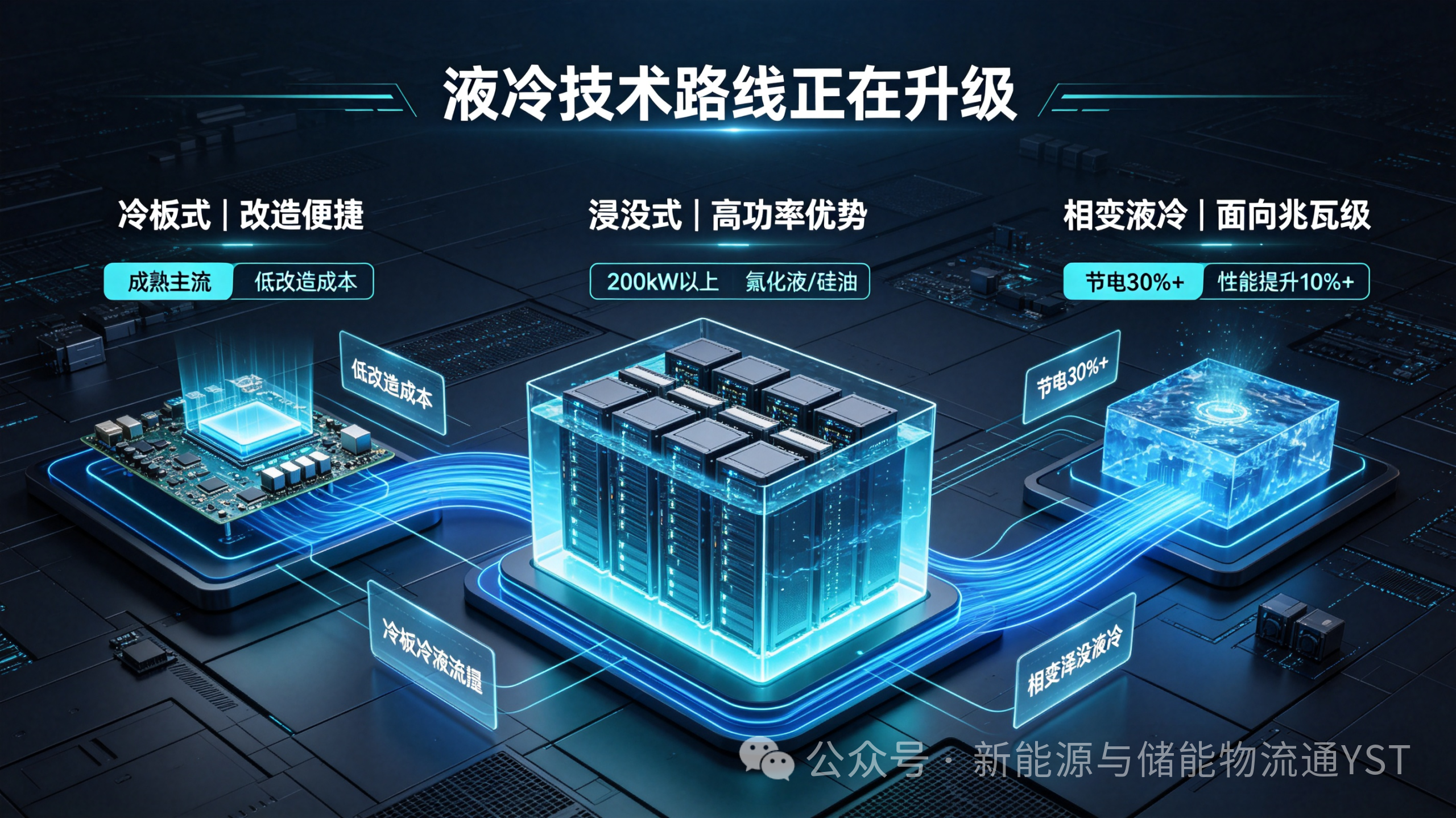
Immersion liquid cooling involves submerging servers directly into a dielectric coolant, dramatically increasing heat dissipation efficiency. Its advantages become fully apparent when rack power exceeds 200kW. Available coolants include fluorinated fluids and silicone oils; while fluorinated fluids offer superior overall performance, they come at a higher cost. Silicone oils offer better cost control and faster commercial adoption, though there is still room for optimization.
Domestic solutions for phase-change immersion liquid cooling have already been successfully deployed. By utilizing the phase change of the refrigerant between liquid and gas states to dissipate heat, these systems can support rack power levels reaching the megawatt range. Compared to traditional air cooling, they can reduce electricity consumption by over 30% while boosting chip performance by more than 10%, offering immense potential for future ultra-high-density computing scenarios.
The market has responded clearly. Liquid cooling production lines across various regions are operating at full capacity, with many companies reporting order backlogs extending to the end of the year and significant year-over-year growth in output value. Industry delivery models are also shifting; competition is no longer focused on individual components but is moving toward integrated, prefabricated delivery of entire intelligent computing centers, thereby shortening project construction cycles. Data from CCID Consulting indicates that the domestic market for liquid-cooled data centers is projected to reach 15.98 billion yuan in 2025, a year-on-year increase of 45.2%. Industry analysts forecast that the global market for liquid cooling in intelligent computing is poised to exceed 100 billion yuan by 2026.
Amid the race for computing power, thermal management is no longer merely a supplementary utility; the higher the rack power density, the greater the value of liquid cooling. As AI computing capacity continues to expand, various liquid cooling technologies will continue to evolve and compete for dominance.

Contact: Jane Wang
Phone: +8613287005502
Tel: +86 533 3595637
Email: info@zbyesmore.com jane@zbyesmore.com
Add: Shandong province,China


