Welcome: SHANDONG YESMORE LOGISTICS CO.,LTD
Language:
 ∷
∷

∷
 ∷
∷


Anyone engaged in Europe-focused foreign trade or cross-border e-commerce has almost certainly heard of EC Certification.
Many mistakenly regard it as an optional qualification or an ordinary product test report. In reality, it is a mandatory entry pass for goods to enter the EU market. Without it, shipments are highly likely to be detained, returned or fined; online stores may face delisting or permanent suspension, and all your painstakingly built European sales channels could collapse overnight.
This comprehensive guide will break down everything about EC Certification: its definition, applicable product categories, core functions and common misconceptions. It helps manufacturers, foreign traders and cross-border sellers achieve full compliance and smooth overseas expansion.
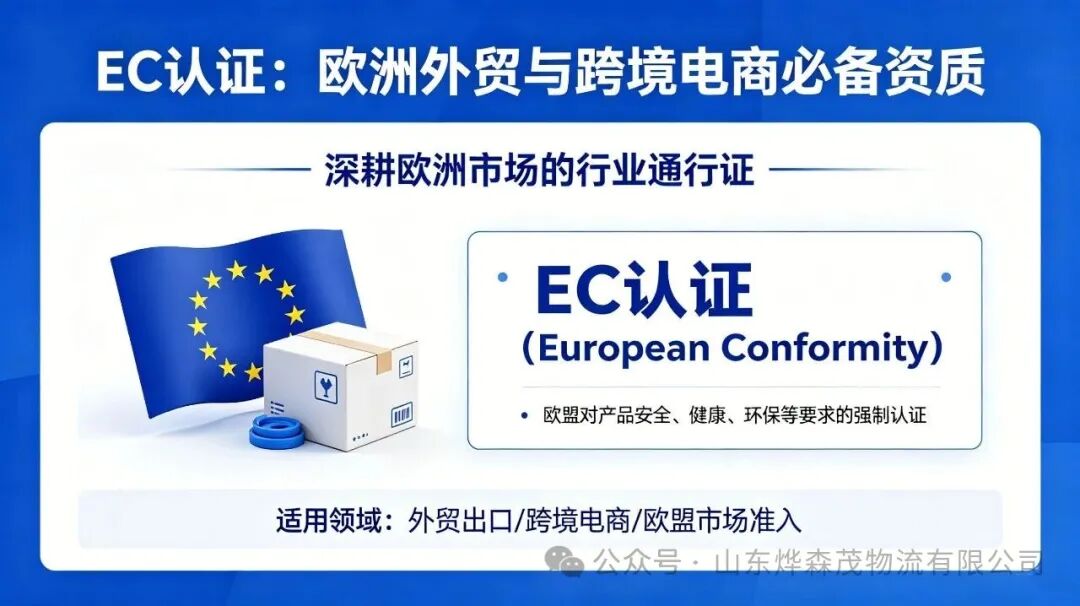
EC Certification, short for EC Conformity Certification, shares the same origin and system as the widely known CE Mark. It is an official EU compliance verification framework for products.
Simply put: it is a mandatory market access standard formulated by the EU to safeguard regional commodity safety, public health and ecological environment.
Most people confuse EC and CE; here is a plain-language distinction:
CE Mark: The compliance logo printed on products and outer packaging, the intuitive "compliance label" visible to customs and consumers.
EC Certification: A full set of official compliance documents including EC Declaration of Conformity (DoC), third-party EC certificates and test reports. It serves as core evidence for customs inspection and platform audits.
All compliant goods entering the 27 EU Member States and European Free Trade Association (EFTA) must complete EC conformity assessment and bear the CE Mark. Only then can products circulate freely and be sold legally across the region, without repeated adaptation to separate national local standards.
EC Certification covers the vast majority of industrial and consumer goods exported to Europe, nearly all mainstream export categories. Key applicable product lines are listed below:
Power supplies, adapters, lighting fixtures, small home appliances, digital devices, smart home products, wires & cables, etc. Subject to LVD (Low Voltage Directive) and EMC (Electromagnetic Compatibility Directive).
Small machinery, automated devices, hardware tools, equipment spare parts, etc. Must comply with the Machinery Safety Directive.
Children’s toys, maternity products, educational toys, etc. Under strict control of material safety, heavy metal content and flame retardancy.
Medical masks, protective clothing, testing equipment, household medical devices, etc. Classified certification under MDR (Medical Device Regulation) and IVDR (In Vitro Diagnostic Devices Regulation). High-risk products require certificates issued by EU Notified Bodies.
Automotive components, vehicle-mounted accessories, non-motor vehicles, transport fittings, etc.
Building materials, coatings, rubber & plastic products, certain chemical supplies, etc.
Critical Reminder: No exceptions apply. Any products sold in the EU—whether via offline foreign trade or cross-border platforms (Amazon, AliExpress, independent sites, etc.)—within regulated categories are obligated to obtain full EC compliance.
Many factories and sellers consider certification cumbersome, time-consuming and costly. In fact, EC certification delivers the highest return on investment for European market expansion, with far-reaching advantages outweighing expenses:
Smooth Customs Clearance & Eliminate Cargo Losses EU customs conduct rigorous inspections. Goods lacking complete EC compliance documents or with unclear CE Marking will be detained, returned or even destroyed, incurring steep detention fees and fines. Complete EC certification files guarantee hassle-free customs release.
Platform Compliance & Stable Store Operation European cross-border platforms enforce strict product compliance audits. Listings without valid EC certificates or Declaration of Conformity will be forcibly removed, links deleted, stores suspended or funds frozen. Compliance certification lays the foundation for long-term store operation.
Risk Mitigation & Fewer After-Sales Disputes EU consumer protection regulations are extremely stringent. Merchants face massive compensation claims and mandatory product recalls in case of safety hazards. EC certification proves products meet EU safety, environmental and health standards, drastically cutting compliance risks and consumer disputes.
Enhanced Product Competitiveness & Access to Premium Buyers Overseas large purchasers, brand owners and supermarket chains always prioritize EC compliance credentials. Valid formal EC certification demonstrates enterprise credibility and acts as a stepping stone to secure major orders and deepen presence in European markets.
Pan-Regional Circulation & Reduced Long-Term Compliance Costs One-time EC conformity assessment enables unrestricted sales across all EU member states, eliminating duplicate testing and certification for individual countries and slashing recurring overseas compliance expenses.
Most enterprises fall into compliance traps by failing to distinguish the two certification modes, resulting in invalid, unrecognized certificates. EC certification falls into two primary categories:
For low-risk ordinary products such as general small home appliances, daily necessities and standard hardware. Enterprises draft and issue their own EC Declaration of Conformity supported by compliant test reports, taking full legal responsibility for product conformity. This mode features fast turnaround and low costs, the top choice for most conventional goods.
Mandatory for high-risk regulated products including medical devices, special equipment, certain machinery and explosion-proof goods. Testing, review and certification must be completed by EU-authorized Notified Bodies, issuing certificates with supreme legal authority. This is also a hard requirement for high-value foreign trade orders and large supermarket distribution channels.
This is completely wrong. The CE Mark is merely a logo, while EC certification refers to the full compliance document package. Customs and platform inspectors will not accept only the printed logo; complete EC certificates, test reports and Declaration of Conformity are mandatory for verification.
EC certification is issued per product and per applicable directive. Different product categories or specifications correspond to distinct EU directives, and certificates cannot be cross-used. Mixing certificates will result in immediate non-compliance rulings.
EU regulations are updated on an ongoing basis. Any modifications to product structure, materials or manufacturing processes will invalidate existing certification, requiring re-testing and renewal. High-risk product certificates carry fixed expiry dates and must undergo re-audit before expiration.
The market is flooded with fake and cloned certificates that appear cheap but are instantly flagged invalid by customs and e-commerce platforms. Once penalized, enterprises will carry permanent compliance records that disrupt all future European export business. Always engage formal, accredited certification bodies.
The European market has high entry barriers and strict supervision, yet it remains the global premium market with steady profit margins and sustained consumer demand.
For enterprises expanding overseas, EC certification is not an expense, but the minimum threshold and core competitive edge to tap European markets. Proactive compliance planning not only avoids losses from cargo detention, store suspension and fines, but also raises product premium pricing and unlocks high-quality overseas order resources.
Contact: Jane Wang
Phone: +8613287005502
Tel: +86 533 3595637
Email: info@zbyesmore.com jane@zbyesmore.com
Add: Shandong province,China


